Frequently
Asked Questions
Frequently Asked Questions (FAQs)
About Barcodes
We’ve put together a list of questions based on our customer’s inquiries. If you don’t see your question answered here or would rather talk to someone, please feel free to give us a call at 307.217.5352.
 Barcode Basics
Order & EZUPC QuestionsBarcode Requirements for
Most Retailers
GS1, Barcode Registration & ValidationBarcode HistoryBarcode Basics
Do You Print Barcode Labels?
No, we do not. We recommend our partner company We Print Barcodes for affordable and fast labels. They have been in the business for over 30 years and also sell barcode scanners and printing equipment.
What is a GTIN? A UPC? An EAN?
Excerpted from Wikipedia:
“Global Trade Item Number (GTIN) is an identifier for trade items developed by GS1 (comprising the former EAN International and Uniform Code Council)[citation needed]. Such identifiers are used to look up product information in a database (often by inputting the number through a barcode scanner pointed at an actual product) which may belong to a retailer, manufacturer, collector, researcher, or other entity. The uniqueness and universality of the identifier is useful in establishing which product in one database corresponds to which product in another database, especially across organizational boundaries.
GTIN is an “umbrella” term used to describe the entire family of GS1 data structures for trade items (products and services) identification. GTINs may be 8, 12, 13 or 14 digits long, and can be constructed using any of four numbering structures, depending upon the exact application. GTIN-8s will be encoded in an EAN-8 barcode. GTIN-12s may be shown in UPC-A, ITF-14, or GS1-128 barcodes. GTIN-13s may be encoded in EAN-13, ITF-14 or GS1-128 barcodes, and GTIN-14s may be encoded in ITF-14 or GS1-128 barcodes. The choice of barcode will depend on the application; for example, items to be sold at a retail should be marked with EAN-8, EAN-13, UPC-A or UPC-E barcodes.”
UPC stands for for Universal Product Code and references a unique 11-digit GTIN assigned to an individual product. The UPC was invented in 1973 by George Laurer under contract by IBM as a solution for the grocery store industry to track and control inventory and distribution. An actual number in barcode format ends up with 12 digits because the 12th digit is called the “check digit” and is calculated based on the 11 assigned numbers as a redundancy check in case of data entry error. The check digit validates the reliability of the UPC by adding together the 11 numbers and reducing them to a single value. A GTIN-12 and a UPC-12 are the same thing and it will take many, many years for the world marketplace to accept the use of the new term “GTIN-12” in place of “UPC”. The UPC will probably never go away, only the name will eventually be commonly known as “GTIN-12”. Just as musicians still refer to their recordings as “records” instead of “CDs” even though vinyl records aren’t used anymore, there will likely be a huge percentage of the world population that will always refer to a GTIN-12 as a UPC.
An EAN stands for European Article Number and is simply a 13-digit barcode version of a GTIN, also known as a GTIN-13. The extra digit that allows for country identification. The country flag merely indicates from which country the range of numbers was originally assigned. It does not indicate the location or ownership or origin of the product using the number. According to George Laurer, many countries are using the same symbol with their identifying country flag, but chose to call the symbol by other names. An example is JAN (Japanese Article Number), the Japanese version. The UPC symbol has truly become worldwide and all barcoding software is programmed to read UPC barcodes, however not all companies have updated their software in North America, and therefore not all North American retailers are able to read 13-digit EAN codes. Retailers were requested to implement the upgrade in 2005, however there are still some who have not done it.
Who needs and uses GTINs/UPCs/EANs and Barcodes?
When you go to sell your product at a retail outlet, that retailer will have you fill out a product information form which tells them the details of your product. Every retail outlet keeps track of their inventory—no matter how small. Unless your retailer is the vegetable stand at the farmer’s market, they probably have an inventory system that is based on barcodes in order to keep track of the products they sell, what price, and where they get the product.
A product information form is where you will put your company info, product details, and enter the 12-digit UPC (GTIN-12) that is assigned to each of your products. If you are selling t-shirts, a blue large t-shirt needs to have a separate UPC from a pink large t-shirt. If you are selling jam, strawberry 16 oz. needs to have a separate UPC from 4 oz. strawberry.
Based on the information you fill out on your form, and the corresponding barcode you put on your product(s), when the retailer scans your product barcode at the register it will call up the information in their system that was provided on your form and therefore gives you credit for the sale. So to simplify things, a barcode is just the numeric/graphical code that keeps track of your product. It’s an inventory tracking tool.
If you are selling your products yourself at the swap meet or farmer’s market, then you don’t need UPCs.
What is the difference between a UPC, EAN, GTIN and a Barcode?
A UPC (GTIN-12)/EAN (GTIN-13) is the number assigned to a product sold in a retail store as explained above. A barcode is simply a graphical translation of a UPC (GTIN-12)/EAN (GTIN-13) number into bars and spaces of varying widths. A barcode is designed to be scanned by an optical reader that interprets the bar and space widths and translates that into the number represented by the bars because reading straight lines is easier than numerical digits.
You can have a UPC (GTIN-12)/EAN (GTIN-13) but not have a barcode. You cannot have a barcode that is not based on a UPC (GTIN-12)/EAN (GTIN-13) . You need a barcode in order to have your UPC (GTIN-12)/EAN (GTIN-13) be scannable by barcode readers in retail stores. You do not need a scannable barcode for online sales—your UPC (GTIN-12)/EAN (GTIN-13) is sufficient.
The barcode generated by a GTIN-13 (EAN) is exactly the same as its GTIN-12 (UPC) counterpart. The only difference is in the numbers along the bottom of the bars and spaces. There is NO difference in the actual barcode of a UPC and an EAN and barcode scanners do not know the difference between a GTIN-13/EAN and a GTIN-12/UPC. If you have a UPC you do not need an EAN. If you live outside the US you may use an EAN or a UPC. Ask your retailer if they want a 12-digit or 13-digit barcode. We can provide you with both.
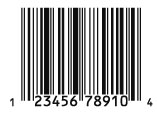 This is a sample UPC (GTIN 12).
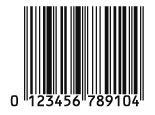 And this is a sample EAN (GTIN 13) of the same number.
You can see that the bars are exactly the same other than the format of the digits below the bars.
Do I need more than one UPC?
You need a UPC and associated barcode for every product variety you are selling. Your UPC (GTIN-12) by itself does not store the information, but when you fill out your product info forms for your products and associate them with your number, you are, in effect, telling retailers the info about your product.
Let’s use Jelly as an example. Let’s say you create jelly in 3 flavors and two sizes: Guava, Strawberry and Strawberry-Guava. You also offer it in two sizes: 8 oz and 16 oz. Therefore you need a UPC for each variety and each size, thus you need 6 separate UPC (GTIN-12)s for your jelly products.
Does every product need a UPC and Barcode?
If you are going to sell your product in retail stores that use an inventory system and a barcode price scanning system, then yes, your products need barcodes. If you are selling your product at the local swap meet and there are no price scanners around, then no, you don’t need a UPC barcode. If you are selling your own products in your own store and don’t have scanning equipment, then you don’t need barcodes, but you still will want to have unique numbers to identify your products. You don’t have to have UPC (GTIN-12) numbers for internal use.
Do your UPC Barcodes work outside the United States?
Yes, the barcode will work anywhere that either UPC or EAN barcodes are scanned throughout the world. This includes North America (Canada, US & Mexico), Central America, South America, Europe, the South Pacific including New Zealand & Australia, Indonesia, Asia, India and the Middle East—anywhere in the world that scans barcodes on products. However, not all EAN codes can be read by all retailers in North America.
Is a UPC or EAN the same as an ISBN or ISSN?
Not entirely. The International Standard Book Number (ISBN) is a 13-digit GTIN that uniquely identifies books and book-like products published internationally because of the prefix used (978-979) and the International Identifier for Serials (ISSN) is for serial publications such as Magazines.
UPCs are for retail products other than books and magazines. You can obtain an ISBN number at ISBN.org. However they will attempt to charge you an additional $25 for your actual barcode at the time of your purchase through their partner company Bowker Barcodes. You do not need to pay that exhorbitant price! We can create your barcode based on your ISBN number for only $2 each and even less the more you need, and it will be provided in more formats and better quality than Bowker Barcodes. Go to MyBarcodeGraphics.com to get your ISBN barcodes and save hundreds of dollars!
If you are publishing a magazine, you may need an ISSN (also formerly known as a Bipad number), not an ISBN (it depends on your distributor). Obtain your ISSN from https://www.issn.org/. A Bipad is just a UPC but under a certain prefix and it is antiquated but some still use it).
What kind of data is stored in my barcode?
Technically none. The lines and spaces are simply a glyph/symbology that was invented by George Laurer that translates your number into lines that can be read by an optical reader (scanner). The data about your product, such as price and product size and name, is up to you to provide your retailers when you fill out their product information form.
If you are not consistent with your information that you provide, it is possible that Retailer A will show your product as one thing, and Retailer B will show it as another. Therefore it’s important that you make sure you are consistent with your product information that you are associating with your GTINs/UPCs.
Can you give me barcode numbers that start with numbers for my country?
No. Our numbers originate from the USA. However, that does not affect your ability to use them in your country. You can use them anywhere in the world and it is not necessary for you to buy numbers from your country’s GS1 organization.
Can I make my own barcodes?
Yes and no. You can make your own barcode graphics files from the numbers you buy, but you cannot make up your own barcode numbers. There are software programs you can buy if you have a lot of barcodes to make. It will be more cost-effective for you to do it that way, as long as you know how to use the software. There are also websites claiming to offer free barcode generators, however the quality of the graphic files provided is often not sufficient to meet GS1 optical reader specs.
If you purchased your numbers from the GS1, or have numbers such as ISBN or ISSN, you can use our low-priced barcode graphic service MyBarcodeGraphics.com and you will be getting a guaranteed barcode in multiple professional file formats that will definitely work on your product labeling when printed within GS1 specs. Another thing to watch out for is barcode fonts. While you can obtain the Code 39A font to translate numbers into barcode lines and spaces, you need to make sure you understand the output requirements in terms of size and resolution so you barcodes are scannable. You also need to make sure you have calculated your check digit correctly. Download our free Barcode Standards Output & Sizing Guide.
What if my UPC is the same as someone else’s?
Whether you purchase your UPC (GTIN-12) from the GS1 or us, your number will never be duplicated. We are assigned a group of numbers within our manufacturer’s prefixes that we rightfully own and any numbers within that group will never be duplicated by us.
When we assign you numbers we provide you with a Certificate of Ownership, Authenticity and Uniqueness, stating that your number(s) are unique and will never be assigned or used for another product.
While it is extremely rare, it does happen—especially on Amazon because they failed to verify ownership of UPCs and EANs up until a few years ago and a lot of people got away with frauduletly using numbers that they didn’t own.
If you do come across another product with the same UPC as the one issued to you by EZ UPC, contact us immediately and we will look into it and issue you replacement if necessary as that is much faster and easier than trying to get the illegal user to stop using it.
Does my UPC have an expiration date?
No. Just like our manufacturer’s prefixes that were assigned by the Uniform Code Council (now the GS1), your UPC will not expire, as it is a subset of one of our prefixes and those prefixes were assigned to us as a company asset in perpetuity (forever). Your purchase agreement and certificate of authenticity confirm this also. You will never have to pay an annual fee or any other hidden charges for your numbers that you purchase from EZUPC.
Am I required to have UPCs for my products?
Technically no, however in today’s world most all retailers use UPC barcodes as an inventory/pricing control. It really is up to your retailer. If you are selling your products yourself at the swap meet or farmer’s market, then you don’t need UPCs. If you use an internal inventory control barcoding system, you can use SKUs and do not need to buy unique barcode numbers for your products.
Order & EZUPC Questions
How Fast Does My Order Come?
Your order will be filled immediatley within minutes—depending on your quantity it will be instant or if ordering a large quantity such as 1000, it may take up to 15 minutes. All orders are sent via email in the form of a Download link to a Zip File that contains your complete order. You may have to check your spam folder.
Help! My number didn't work on Amazon.
First make sure you entered all 12 digits if using UPC or 13 digits if using EAN. These can be found in your Codes_Order#.csv document with your order. If it’s not that, 99% of the time the reason why you had a problem is because you failed to follow our instructions that come with your order on how to properly use your numbers on Amazon. Please email us a screen shot of exactly what the message is that you are getting and we will help you successfully list your product.
In the unlikely event that your number is fraudulently being used by someone else, we will issue you a replacement.
Will I get both UPC and EAN Codes?
You will get only UPC codes if you are in North America. For everyone else you will receive both UPC Code and EAN Code graphics files with your order. For each number you purchase you will get print-ready barcode graphics in Vector EPS, PDF and TIF for both the UPC and the EAN.
If your address is in North America but you would like EAN codes you will have to email us a request for them as our automatic order fulfillment system will not issue you EAN codes with a North American address.
What if my UPC is the same as someone else’s?
Whether you purchase your UPC (GTIN-12) from the GS1 or us, your number will never be duplicated. We are assigned a group of numbers within our manufacturer’s prefixes that we rightfully own and any numbers within that group will never be duplicated by us.
When we assign you numbers we provide you with a Certificate of Ownership, Authenticity and Uniqueness, stating that your number(s) are unique and will never be assigned or used for another product.
While it is extremely rare, it does happen—especially on Amazon because they failed to verify ownership of UPCs and EANs up until a few years ago and a lot of people got away with frauduletly using numbers that they didn’t own.
If you do come across another product with the same UPC as the one issued to you by EZ UPC, contact us immediately and we will look into it and issue you replacement if necessary as that is much faster and easier than trying to get the illegal user to stop using it.
What if my UPC doesn’t work or a retailer won’t accept it?
What we have found is that if you are working with Walmart and Kroger stores at a local level, they don’t get involved in the GS1 politics. It’s only when you get a national distribution contract that requires you to work with their Corporate Headquarters or on a National level and submit your product data to a certified Data Pool, that they are strict about enforcing the political rule that you must provide an ownership certificate directly from the GS1.
Other stores that have been reported to require a GS1 Certificate as well as an owned company prefix in recent years include: Macy’s, Bloomingdales, Lowes, Walgreens, Target, however we also have many customers who have used our numbers in those stores over the years. It’s a bit hit or miss these days as the GS1 and the Global Data Synchronization Network (GDSN) effort becomes more widely used.
Remember, if you get a sizeable contract at a big box retailer, you will likely have to pay the price to go through the GS1 and at that point you can justify the cost depending on the price of the contract. For everyone else, EZ UPC is a cost-effective and hassle-free alternative or a great stepping stone while you are scaling your small business.
We are not responsible for retailers that refuse to accept numbers from a legal reseller or require a GS1 certificate and prefix.
Will I get a Company Prefix and/or GLN (Global Location Number)?
You will not get a Company Prefix from us. And you mostly likely don’t need one. When you purchase GTINs/UPCs from EZ UPC, you are purchasing unique numbers under one of our manufacturer’s prefixes that we legally own and can legally assign to you because we obtained them prior to the class action lawsuit and settlement with the GS1 in 2002.
Prefixes aren’t really used the way they were 15-30 years ago and it is not necessary to have one for your company. What is more important is a GLN (Global Location Number) which your distributor may ask you for. This will identify your company and it’s location in the distributor’s network and all your products will be logged in their database under your GLN. Large companies with multiple facilities will have multiple GLNs, but for the vast majority of small and medium sized businesses you will only have one. If you purchase numbers from us and are being asked for a GLN, please contact us and we will tell you how to get a GLN.
Who is George Laurer and Why Does it Matter?
George invented the UPC (Uniform Product Code) in 1973 under contract with IBM. He used to maintain a website with all the information about the origin of the UPC, the UCC and the GS1, and also shared details and info about the class action lawsuits against the Uniform Code Council (now the GS1), as well as listing other legal resellers like ourselves.
We were one of the first resellers he verified and listed on his website. His site used to explain about the mechanics of barcodes and the numbering system and shared great advice on how to determine if people like us are legal and legitimate. He also had a blacklist of websites he had found to be fraudulent or suspicious.
Unfortunately several resellers who made plenty of money off of unsuspecting and trusting customers threatened him with legal action in late 2016 and at 91 years old, he threw in the towel and removed the information on his site that had been there for 15 years. The sad thing is he was only trying to help by giving information so people wouldn’t be victims of fraud.
George passed away in December 2019 at the age of 94. AP News: George Laurer, inventor of ubiquitous UPC, dies at 94
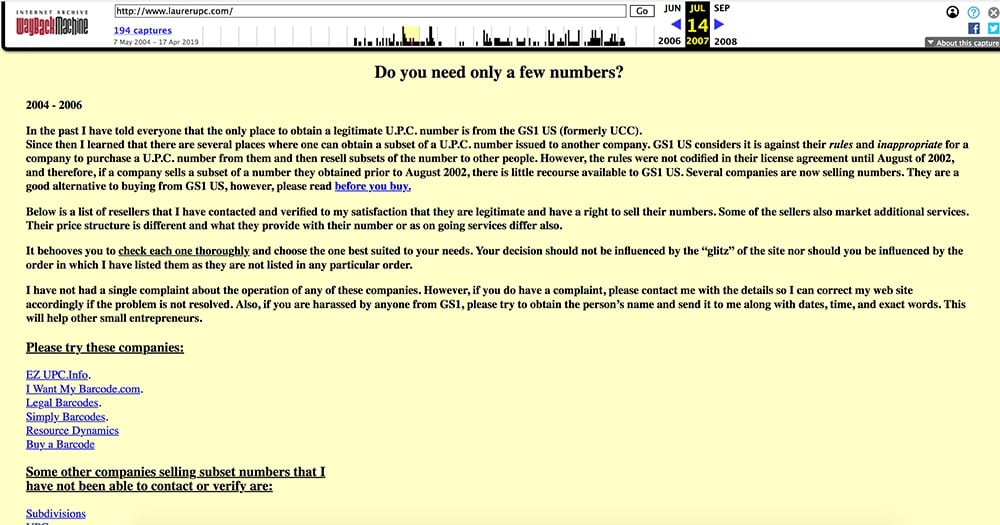
His website can be viewed in the internet Wayback Machine. You have to view prior to 2016 to see the content prior to his removing of the recommended companies (like ours) and those on his Black List, which he removed when he was legally threatened in 2016.
Here is our site on his recommended list in July 2007:
Why Isn't EZUPC BBB Accredited?
The Better Business Bureau (BBB) is a membership-based organization, kind of like an original Yelp for reviews. They allow anyone to write reviews/make complaints, but if a company wants to respond to those reviews/complaints, they have to join the BBB membership and pay fees.
Thus, the reason why we aren’t BBB Accredited is because we don’t have any complaints against us and don’t choose to spend the money on their membership.
Barcode Requirements for
Most Retailers
Am I required to have UPCs for my products?
Are your numbers accepted everywhere?
Unfortunately there are a handful of major retailers that will likely require you to lease your numbers from the GS1 so you cannot buy from us if you are putting your products in their stores. These include Walmart retail stores at the national level and some regional (and Sam’s Club), any Kroger owned grocery store including Fred Meyer, any May Company Department stores such as Macy’s, Bloomingdales and Lord & Taylor. These stores might not accept UPCs purchased from a reseller like us as they may require you to show that you have spent way too much money and purchased your numbers directly from the GS1. This is because they share board members and are participating with the GS1 exclusively. However, we also have reports of many businesses being successful getting their products into these stores with our numbers—especially at the local or regional levels.
Please note that we are not responsible in any way for any retailer that does not choose to accept your GTIN(s) and we do not refund transactions if you encounter a retailer that does not accept your numbers after 14 days of purchase. There are hundreds of thousands of retailers who have accepted our numbers since 2007 and millions of retailers out there who will. We recommend you do your due diligence and study the information on our site and make sure you will not have an issue with your retailer before you buy or in the 14 day period. You are required to report to us any Retailers or Distributors who refuse to allow you to use the numbers you purchase from us.
Will my barcode numbers from you show my Company Name?
No. Barcode numbers don’t hold any information other than the number. When you first use your numbers, you will be asked by your retailer or distributor to enter your product information in a form for use in their database so your product info shows when it is scanned at their cash registers. It’s 100% up to you to tell them what your product is and what the UPC code is that you assigned to it and it doesn’t matter if your product shows up in a retailer’s database where your product is not sold!
The GS1 will try to tell you that your numbers must appear in their database under your company name and that is 100% false. The GS1’s database is incomplete and only shows a fraction of the world’s barcodes.
How do I register my UPC?
Quite simply, you don’t. Even the GS1 does not “register” individual GTINs/UPCs/EANs. It is up to the purchaser to upload the individual product information into the GS1’s database, or to any other retailer or distributor’s database.
IMPORTANT: There is no central barcode database or registry that has a directory of all of the gazillions of individual product barcodes in use throughout the world!
The GS1 claims to be the most used worldwide, however even their GEPIR database is outdated and the purchaser of the barcodes is responsible for providing individual product information to them, which they can only do if they have an active, paid membership with the GS1!
For example, I have a package of Avery 8160 Address Labels on my desk and the UPC for them is 072782081607. That product has been around for decades and is probably one of Avery’s most popular products. When I enter that UPC into the GS1’s GEPIR database under GTIN info, it tells me that the Owner is Avery Products Corporation, however when I toggle Trade Item Information it returns nothing. This is because Avery has not uploaded that information to the GS1 ever, in decades! This is likely because Avery purchased their manufacturer’s prefix in the late 80s or early 90s and they choose not to pay the GS1’s ridiculous annual membership fees that were implemented in the 2000s after they agreed to the Class Action Settlement against them for illegally attempting to collect membership fees from companies who had been sold assets in perpetuity.
The fact is, when you first use your numbers, you will be asked by your retailer or distributor to enter your product information in a form for use in their database so your product info shows when it is scanned at their cash registers. It’s 100% up to you to tell them what your product is and what the UPC code is that you assigned to it and it doesn’t matter if your product shows up in a retailer’s database where your product is not sold!
When you purchase GTINs/UPCs from EZ UPC, you are purchasing unique numbers under one of our manufacturer’s prefixes that we legally own and can legally assign to you because we obtained them prior to the class action lawsuit and settlement with the GS1 in 2002.
Do your UPC Codes work outside the United States?
Will my Company Name show up in the GS1 GEPIR database if I buy numbers from you?
No. The GS1 claims to be the most used worldwide, however even their GEPIR database is outdated and the purchaser of the barcodes is responsible for providing individual product information to them, which they can only do if they have an active, paid membership with the GS1 which costs hundreds if not thousands of dollars a year!
IMPORTANT: There is no central barcode database or registry that has a directory of all of the gazillions of individual product barcodes in use throughout the world!
For example, I have a package of Avery 8160 Address Labels on my desk and the UPC for them is 072782081607. That product has been around for decades and is probably one of Avery’s most popular products. When I enter that UPC into the GS1’s GEPIR database under GTIN info, it tells me that the Owner is Avery Products Corporation, however when I toggle Trade Item Information it returns nothing. This is because Avery has not uploaded that information to the GS1 ever, in decades! This is likely because Avery purchased their manufacturer’s prefix in the late 80s or early 90s and they choose not to pay the GS1’s ridiculous annual membership fees that were implemented in the 2000s after they agreed to the Class Action Settlement against them for illegally attempting to collect membership fees from companies who had been sold assets in perpetuity.
The fact is, when you first use your numbers, you will be asked by your retailer or distributor to enter your product information in a form for use in their database so your product info shows when it is scanned at their cash registers. It’s 100% up to you to tell them what your product is and what the UPC code is that you assigned to it and it doesn’t matter if your product shows up in a retailer’s database where your product is not sold!
When you purchase GTINs/UPCs from EZ UPC, you are purchasing unique numbers under one of our manufacturer’s prefixes that we legally own and can legally assign to you because we obtained them prior to the class action lawsuit and settlement with the GS1 (formerly UCC) in 2002.
Can you give me barcode numbers that start with numbers for my country?
No. Our numbers originate from the USA. However, that does not affect your ability to use them in your country. You can use them anywhere in the world and it is not necessary for you to buy numbers from your country’s GS1 organization.
What if my UPC doesn’t work or a retailer won’t accept it?
If you got an error message on Amazon, send us a screen shot of the message and we can help you
Some Walmart stores or regions, and some Kroger Family Grocery stores (such as superstore Fred Meyer) might not accept your subset numbers(s) if they are not purchased through the GS1–they require your own GS1 certificate. We also have reports of people successfully submitting their numbers and providing their certificate from us to these stores and not being asked for a GS1 Certificate.
What we have found is that if you are working with Walmart and Kroger stores at a local level, they don’t get involved in the GS1 politics. It’s only when you get a national distribution contract that requires you to work with their Corporate Headquarters or on a National level and submit your product data to a certified Data Pool, that they are strict about enforcing the political rule that you must provide an ownership certificate directly from the GS1.
Other stores that have been reported to require a GS1 Certificate as well as an owned company prefix in recent years include: Macy’s, Bloomingdales, Lowes, Walgreens, Target, however we also have many customers who have used our numbers in those stores over the years. It’s a bit hit or miss these days as the GS1 and the Global Data Synchronization Network (GDSN) effort becomes more widely used.
Remember, if you get a sizeable contract at a big box retailer, you will likely have to pay the price to go through the GS1 and at that point you can justify the cost depending on the price of the contract. For everyone else, EZ UPC is a cost-effective and hassle-free alternative or a great stepping stone while you are scaling your small business.
We are not responsible for retailers that refuse to accept numbers from a legal reseller or require a GS1 certificate and prefix.
What if my UPC is the same as someone else’s?
Whether you purchase your UPC (GTIN-12) from the GS1 or us, your number will never be duplicated. We are assigned a group of numbers within our manufacturer’s prefixes that we rightfully own and any numbers within that group will never be duplicated by us.
When we assign you numbers we provide you with a Certificate of Ownership, Authenticity and Uniqueness, stating that your number(s) are unique and will never be assigned or used for another product.
While it is extremely rare, it does happen—especially on Amazon because they failed to verify ownership of UPCs and EANs up until a few years ago and a lot of people got away with frauduletly using numbers that they didn’t own.
If you do come across another product with the same UPC as the one issued to you by EZ UPC, contact us immediately and we will look into it and issue you replacement if necessary as that is much faster and easier than trying to get the illegal user to stop using it.
Can I make my own barcodes?
Yes and no. You can make your own barcode graphics files from the numbers you buy, but you may not make up your own numbers. There are software programs you can buy if you have a lot of barcodes to make. It will be more cost-effective for you to do it that way, providing you know how to use the software. There are also websites claiming to offer free barcode generating, however the quality of the graphic file provided is often not sufficient to meet GS1 optical reader specs.
If you use our low-priced barcode service you will be getting a guaranteed barcode in multiple professional file formats that will definitely work on your product labeling when printed within GS1 specs (no less than 80% size, no more than 200%, and dark lines on light background, printed at 600 dpi or more). Another thing to watch out for is barcode fonts. While you can obtain the Code 39A font to translate numbers into barcode lines and spaces, you need to make sure you understand the output requirements in terms of size and resolution so you barcodes are scannable. You also need to make sure you have calculated your check digit correctly.
Also beware of costly barcode services such as Bowker Barcodes, as referred on the ISBN.org website. They charge $25 for the exact same service that we charge $2.99 at our sister site My Barcode Graphics and we actually give you more file formats and better quality. If you need a lot of barcodes (more than 20) we offer bulk pricing.
Does my UPC have an expiration date?
What is the GS1?
From Wikipedia:
GS1 is a not-for-profit organization that develops and maintains global standards for business communication. The best known of these standards is the barcode, a symbol printed on products that can be scanned electronically. GS1 barcodes are scanned more than six billion times every day.
GS1 has 114 local member organisations and 1.5 million user companies.
GS1 standards are designed to improve the efficiency, safety and visibility of supply chains across physical and digital channels in 25 sectors. They form a business language that identifies, captures and shares key information about products, locations, assets and more.
History
In 1969, the retail industry in the US was searching for a way to speed up the check-out process in shops. The Ad Hoc Committee for a Uniform Grocery Product Identification Code was established to find a solution.
In 1973, the Universal Product Code (UPC) was selected by this group as the first single standard for unique product identification, and in 1974, the Uniform Code Council (UCC) was founded to administer the standard.[1] On 26 June 1974, a pack of Wrigley’s chewing gum became the first ever product with a barcode to be scanned in a shop.[1][3]
In 1976, the original 12-digit code was expanded to 13 digits, which opened the doors for the identification system to be used outside the U.S. In 1977, the European Article Numbering Association (EAN) was established in Brussels and with founding members from 12 countries.[4]
In 1990, EAN and UCC signed a global cooperation agreement and expanded overall presence to 45 countries. In 1999, EAN and UCC launched the Auto-ID Centre to develop Electronic Product Code (EPC) enabling GS1 standards to be used for RFID.[5]
In 2004, EAN and UCC launched the Global Data Synchronization Network (GDSN), a global, internet-based initiative that enables trading partners to efficiently exchange product master data.[4]
By 2005, the organisation was present in over 90 countries which started to use the name GS1 on a worldwide basis. Whilst “GS1” is not an acronym it refers to the organisation offering one global system of standards.[4]
Aug 2018 – GS1 Web URI Structure Standard is ratified allowing unique ID’s to be added to products by storing a URI (a webpage-like address) as a QR code.[6]
Barcodes
Barcodes defined by GS1 standards are very common.[7] GS1 introduced the barcode in 1974.[8] They encode a product identification number that can be scanned electronically, making it easier for products to be tracked, processed, and stored.
Barcodes allow for greater safety, reliability, speed and efficiency of supply chains. They have a crucial role in the retail industry, moving beyond just faster checkout to improved inventory and delivery management and the opportunity to sell online on a global scale. In the UK alone, the introduction of the barcode in the retail industry has resulted in savings of 10.5 billion pounds per year.[1][9]
Some of the barcodes that GS1 manages are: EAN/UPC (used mainly on consumer goods), GS1 Data Matrix (used mainly on healthcare products), GS1-128, GS1 DataBar, and GS1 QR Code.
GS1, Barcode Registration & Validation
How do I register my UPC(s)?
Quite simply, you don’t. Even the GS1 does not “register” individual GTINs/UPCs/EANs. It is up to the purchaser to upload the individual product information into the GS1’s database, or to any other retailer or distributor’s database.
IMPORTANT: There is no central barcode database or registry that has a directory of all of the gazillions of individual product barcodes in use throughout the world!
The GS1 claims to be the most used worldwide, however even their GEPIR database is outdated and the purchaser of the barcodes is responsible for providing individual product information to them, which they can only do if they have an active, paid membership with the GS1!
For example, I have a package of Avery 8160 Address Labels on my desk and the UPC for them is 072782081607. That product has been around for decades and is probably one of Avery’s most popular products. When I enter that UPC into the GS1’s GEPIR database under GTIN info, it tells me that the Owner is Avery Products Corporation, however when I toggle Trade Item Information it returns nothing. This is because Avery has not uploaded that information to the GS1 ever, in decades! This is likely because Avery purchased their manufacturer’s prefix in the late 80s or early 90s and they choose not to pay the GS1’s ridiculous annual membership fees that were implemented in the 2000s after they agreed to the Class Action Settlement against them for illegally attempting to collect membership fees from companies who had been sold assets in perpetuity.
The fact is, when you first use your numbers, you will be asked by your retailer or distributor to enter your product information in a form for use in their database so your product info shows when it is scanned at their cash registers. It’s 100% up to you to tell them what your product is and what the UPC code is that you assigned to it and it doesn’t matter if your product shows up in a retailer’s database where your product is not sold!
When you purchase GTINs/UPCs from EZ UPC, you are purchasing unique numbers under one of our manufacturer’s prefixes that we legally own and can legally assign to you because we obtained them prior to the class action lawsuit and settlement with the GS1 in 2002.
Will my UPCs show up in the GS1's GEPIR database under my Company Name?
No, they will not. And they don’t need to. Please see the question How Do I Register My UPC(s)?
What kind of data is stored in my barcode?
Technically none. The lines and spaces are simply a glyph/symbology that was invented by George Laurer that translates your number into lines that can be read by an optical reader (scanner). The data about your product, such as price and product size and name, is up to you to provide your retailers when you fill out their product information form.
If you are not consistent with your information that you provide, it is possible that Retailer A will show your product as one thing, and Retailer B will show it as another. Therefore it’s important that you make sure you are consistent with your product information that you are associating with your GTINs/UPCs.
What if my UPC doesn’t work or a retailer won’t accept it?
What we have found is that if you are working with Walmart and Kroger stores at a local level, they don’t get involved in the GS1 politics. It’s only when you get a national distribution contract that requires you to work with their Corporate Headquarters or on a National level and submit your product data to a certified Data Pool, that they are strict about enforcing the political rule that you must provide an ownership certificate directly from the GS1.
Other stores that have been reported to require a GS1 Certificate as well as an owned company prefix in recent years include: Macy’s, Bloomingdales, Lowes, Walgreens, Target, however we also have many customers who have used our numbers in those stores over the years. It’s a bit hit or miss these days as the GS1 and the Global Data Synchronization Network (GDSN) effort becomes more widely used.
Remember, if you get a sizeable contract at a big box retailer, you will likely have to pay the price to go through the GS1 and at that point you can justify the cost depending on the price of the contract. For everyone else, EZ UPC is a cost-effective and hassle-free alternative or a great stepping stone while you are scaling your small business.
We are not responsible for retailers that refuse to accept numbers from a legal reseller or require a GS1 certificate and prefix.
What is the GS1?
From Wikipedia:
GS1 is a not-for-profit organization that develops and maintains global standards for business communication. The best known of these standards is the barcode, a symbol printed on products that can be scanned electronically. GS1 barcodes are scanned more than six billion times every day.
GS1 has 114 local member organisations and 1.5 million user companies.
GS1 standards are designed to improve the efficiency, safety and visibility of supply chains across physical and digital channels in 25 sectors. They form a business language that identifies, captures and shares key information about products, locations, assets and more.
History
In 1969, the retail industry in the US was searching for a way to speed up the check-out process in shops. The Ad Hoc Committee for a Uniform Grocery Product Identification Code was established to find a solution.
In 1973, the Universal Product Code (UPC) was selected by this group as the first single standard for unique product identification, and in 1974, the Uniform Code Council (UCC) was founded to administer the standard.[1] On 26 June 1974, a pack of Wrigley’s chewing gum became the first ever product with a barcode to be scanned in a shop.[1][3]
In 1976, the original 12-digit code was expanded to 13 digits, which opened the doors for the identification system to be used outside the U.S. In 1977, the European Article Numbering Association (EAN) was established in Brussels and with founding members from 12 countries.[4]
In 1990, EAN and UCC signed a global cooperation agreement and expanded overall presence to 45 countries. In 1999, EAN and UCC launched the Auto-ID Centre to develop Electronic Product Code (EPC) enabling GS1 standards to be used for RFID.[5]
In 2004, EAN and UCC launched the Global Data Synchronization Network (GDSN), a global, internet-based initiative that enables trading partners to efficiently exchange product master data.[4]
By 2005, the organisation was present in over 90 countries which started to use the name GS1 on a worldwide basis. Whilst “GS1” is not an acronym it refers to the organisation offering one global system of standards.[4]
Aug 2018 – GS1 Web URI Structure Standard is ratified allowing unique ID’s to be added to products by storing a URI (a webpage-like address) as a QR code.[6]
Barcodes
Barcodes defined by GS1 standards are very common.[7] GS1 introduced the barcode in 1974.[8] They encode a product identification number that can be scanned electronically, making it easier for products to be tracked, processed, and stored.
Barcodes allow for greater safety, reliability, speed and efficiency of supply chains. They have a crucial role in the retail industry, moving beyond just faster checkout to improved inventory and delivery management and the opportunity to sell online on a global scale. In the UK alone, the introduction of the barcode in the retail industry has resulted in savings of 10.5 billion pounds per year.[1][9]
Some of the barcodes that GS1 manages are: EAN/UPC (used mainly on consumer goods), GS1 Data Matrix (used mainly on healthcare products), GS1-128, GS1 DataBar, and GS1 QR Code.
Will my product show up when scanned with a Mobile App?
Mobile Barcode Apps use their own databases which are not necessarily connected to the global data pools.
There is no central barcode database or registry that has a directory of all of the gazillions of individual product barcodes in use throughout the world!
When you submit your product to Amazon, for example, it will look up only in the GS1’s GEPIR database, and the GEPIR is not current with all individual product GTIN info.
The GS1 claims to be the most used worldwide, however even their GEPIR database is outdated and the purchaser of the barcodes is responsible for providing individual product information to them, which they can only do if they have an active, paid membership with the GS1!
Will I get a Company Prefix and/or GLN (Global Location Number)?
You will not get a Company Prefix from us. And you mostly likely don’t need one. When you purchase GTINs/UPCs from EZ UPC, you are purchasing unique numbers under one of our manufacturer’s prefixes that we legally own and can legally assign to you because we obtained them prior to the class action lawsuit and settlement with the GS1 in 2002.
Prefixes aren’t really used the way they were 15-30 years ago and it is not necessary to have one for your company. What is more important is a GLN (Global Location Number) which your distributor may ask you for. This will identify your company and it’s location in the distributor’s network and all your products will be logged in their database under your GLN. Large companies with multiple facilities will have multiple GLNs, but for the vast majority of small and medium sized businesses you will only have one. If you purchase numbers from us and are being asked for a GLN, please contact us and we will tell you how to get a GLN.
Barcode History
What is the GS1?
From Wikipedia:
GS1 is a not-for-profit organization that develops and maintains global standards for business communication. The best known of these standards is the barcode, a symbol printed on products that can be scanned electronically. GS1 barcodes are scanned more than six billion times every day.
GS1 has 114 local member organisations and 1.5 million user companies.
GS1 standards are designed to improve the efficiency, safety and visibility of supply chains across physical and digital channels in 25 sectors. They form a business language that identifies, captures and shares key information about products, locations, assets and more.
History
In 1969, the retail industry in the US was searching for a way to speed up the check-out process in shops. The Ad Hoc Committee for a Uniform Grocery Product Identification Code was established to find a solution.
In 1973, the Universal Product Code (UPC) was selected by this group as the first single standard for unique product identification, and in 1974, the Uniform Code Council (UCC) was founded to administer the standard.[1] On 26 June 1974, a pack of Wrigley’s chewing gum became the first ever product with a barcode to be scanned in a shop.[1][3]
In 1976, the original 12-digit code was expanded to 13 digits, which opened the doors for the identification system to be used outside the U.S. In 1977, the European Article Numbering Association (EAN) was established in Brussels and with founding members from 12 countries.[4]
In 1990, EAN and UCC signed a global cooperation agreement and expanded overall presence to 45 countries. In 1999, EAN and UCC launched the Auto-ID Centre to develop Electronic Product Code (EPC) enabling GS1 standards to be used for RFID.[5]
In 2004, EAN and UCC launched the Global Data Synchronization Network (GDSN), a global, internet-based initiative that enables trading partners to efficiently exchange product master data.[4]
By 2005, the organisation was present in over 90 countries which started to use the name GS1 on a worldwide basis. Whilst “GS1” is not an acronym it refers to the organisation offering one global system of standards.[4]
Aug 2018 – GS1 Web URI Structure Standard is ratified allowing unique ID’s to be added to products by storing a URI (a webpage-like address) as a QR code.[6]
Barcodes
Barcodes defined by GS1 standards are very common.[7] GS1 introduced the barcode in 1974.[8] They encode a product identification number that can be scanned electronically, making it easier for products to be tracked, processed, and stored.
Barcodes allow for greater safety, reliability, speed and efficiency of supply chains. They have a crucial role in the retail industry, moving beyond just faster checkout to improved inventory and delivery management and the opportunity to sell online on a global scale. In the UK alone, the introduction of the barcode in the retail industry has resulted in savings of 10.5 billion pounds per year.[1][9]
Some of the barcodes that GS1 manages are: EAN/UPC (used mainly on consumer goods), GS1 Data Matrix (used mainly on healthcare products), GS1-128, GS1 DataBar, and GS1 QR Code.
Who is George Laurer and Why Does it Matter?
George invented the UPC (Uniform Product Code) in 1973 under contract with IBM. He used to maintain a website with all the information about the origin of the UPC, the UCC and the GS1, and also shared details and info about the class action lawsuits against the Uniform Code Council (now the GS1), as well as listing other legal resellers like ourselves.
We were one of the first resellers he verified and listed on his website. His site used to explain about the mechanics of barcodes and the numbering system and shared great advice on how to determine if people like us are legal and legitimate. He also had a blacklist of websites he had found to be fraudulent or suspicious.
Unfortunately several resellers who made plenty of money off of unsuspecting and trusting customers threatened him with legal action in late 2016 and at 91 years old, he threw in the towel and removed the information on his site that had been there for 15 years. The sad thing is he was only trying to help by giving information so people wouldn’t be victims of fraud.
George passed away in December 2019 at the age of 94. AP News: George Laurer, inventor of ubiquitous UPC, dies at 94
His website can be viewed in the internet Wayback Machine. You have to view prior to 2016 to see the content prior to his removing of the recommended companies (like ours) and those on his Black List, which he removed when he was legally threatened in 2016.
Here is our site on his recommended list in July 2007:
Is EZ UPC Right For You?

Read the main points you should consider to determine if you should buy your UPC/EAN Codes from us.
About Us
This is the No BS TL;DR—What you need to know when you purchase UPC codes from us.
Using EZUPC vs. the GS1

Read the Pros & Cons when it comes to buying barcodes for your products from EZUPC.
FAQs
Answers to all your questions about barcodes for your products
Guarantees
We're the ONLY UPC Reseller site that offers you a
14-Day No-Risk Money Back Guarantee.
Reviews
 See our Customer Love in their own words since 2007. We don't do social media sites, fake stuff or hype—we keep it real.
Customer Care
(We really do answer our phone or will call you back if we miss you or are busy with other customers!)

1309 Coffeen Ave
Suite 1200
Sheridan, WY 82801
Get In Touch